
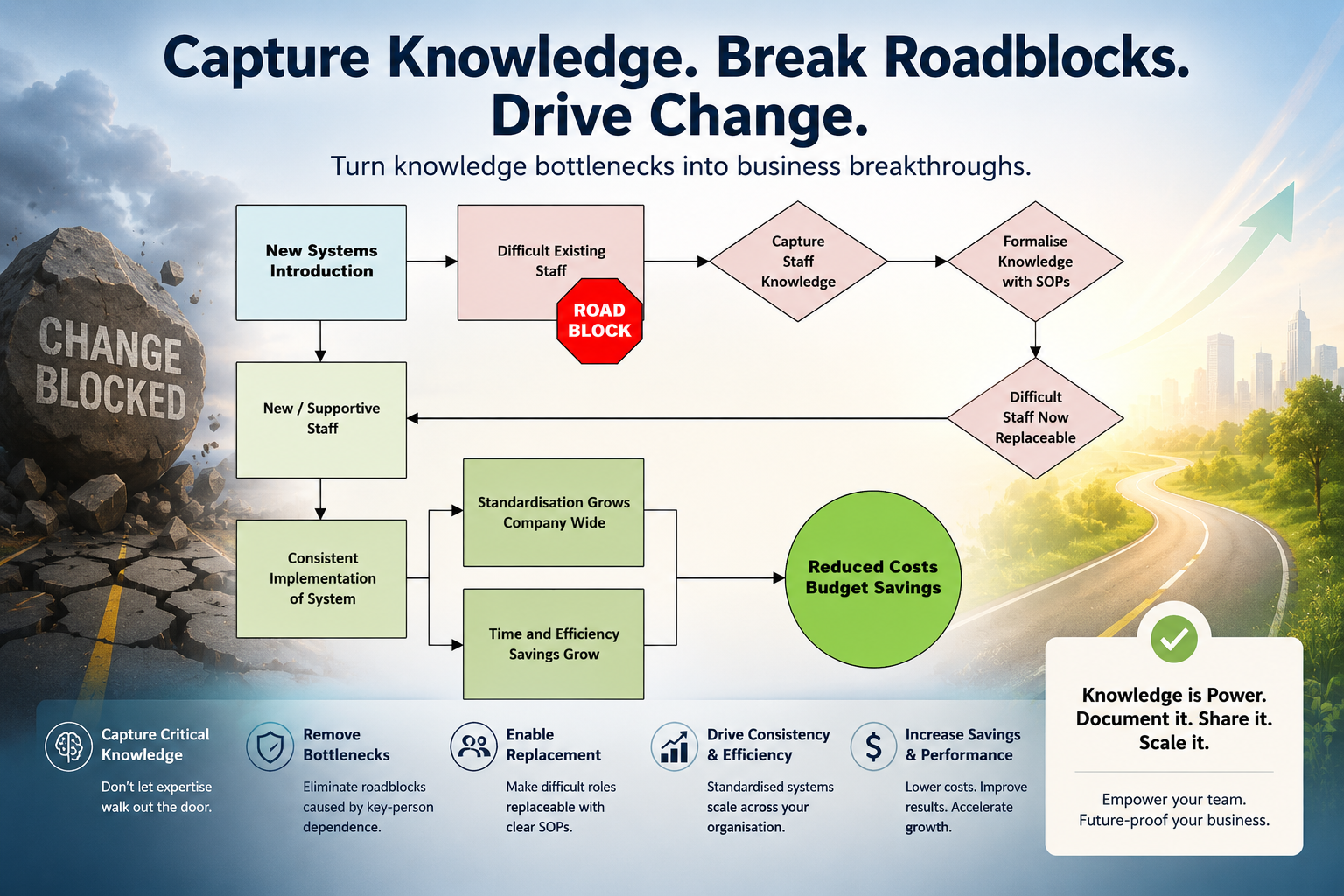
One of the most difficult realities for growing businesses is that the biggest barrier to operational change is sometimes not the system, the budget, or even the market.
It can be the long-serving employee who believes they are irreplaceable.
Most businesses have one.
The person who has “always done it this way”.
The person who knows everything.
The person everyone goes to for answers.
The person who says the new process will never work before it has even been implemented.
At first, this often looks valuable. Experience usually is valuable.
But over time, businesses can accidentally create an operational structure that revolves entirely around one individual’s undocumented knowledge instead of around scalable systems.
That is where problems begin.
Leadership introduces new workflows, systems, accountability structures, or standardisation processes to improve consistency and growth. Everyone is expected to work within the same structure.
Except one person quietly refuses to.
Not necessarily through outright confrontation, but through constant resistance:
working outside the process,
avoiding documentation,
finding reasons the old way is “better”,
or positioning themselves as the only person capable of handling certain tasks correctly.
The business slowly adapts around them because replacing them feels too risky.
And that is the moment the employee stops being an asset to operational growth and starts becoming a bottleneck to it.
The uncomfortable reality is this:
if critical operational knowledge only exists inside one employee’s head, then the business does not own that process.
The employee does.
That creates enormous risk for any company trying to modernise, scale, improve efficiency, or reduce operational inconsistency.
This is why documenting procedures, capturing workflow knowledge, building SOPs, and standardising systems is so important.
Not because experienced staff are unimportant.
But because no business should be held hostage by undocumented knowledge.
Strong operational businesses are built so that systems survive staff turnover, growth, restructuring, and change.
Because eventually every company reaches a point where it must decide whether it is building around personalities…
or building around structure.